
What’s behind Turkey’s massive protests?
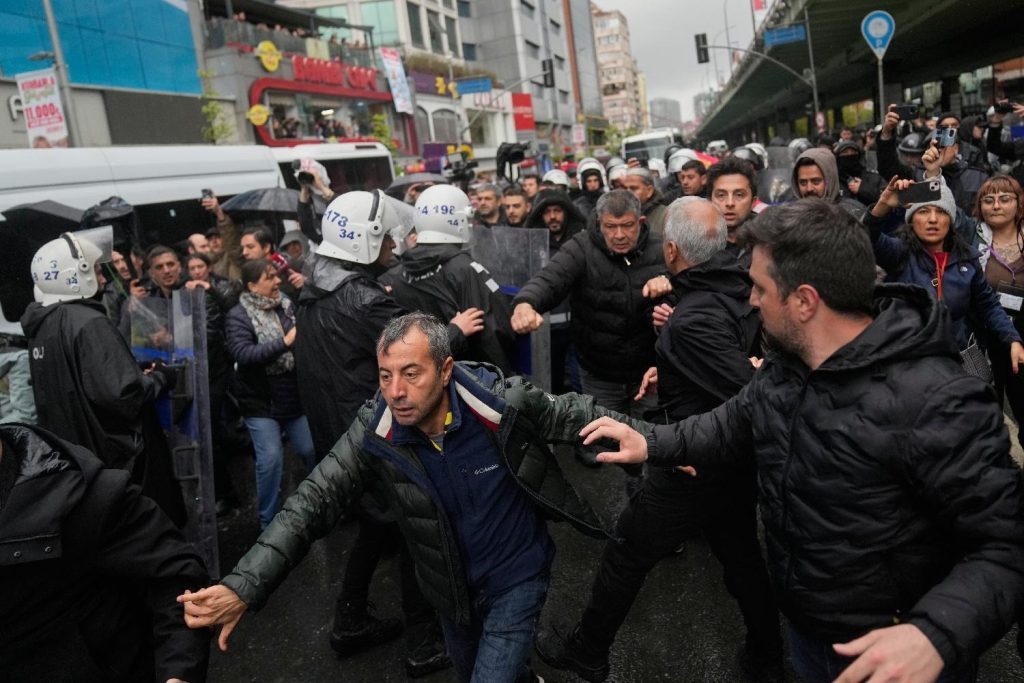
The 24th of May, Turkish riot police fired tear gas and forced their way into the Republican People’s Party’s (CHP), the main opposition party’s headquarters to evict its ousted leadership.
The decision to oust the politician happened two days after President Recep Tayyip Erdogan ordered the closing of Bilgi University, one of the best private universities of Turkey, and less than a month after May Day protests when more than 500 protesters got arrested. Coupled with concerns raised by international human rights organizations over the rule of law and democracy in Turkey, reports of arrests of protesters and restrictions on peaceful gatherings in central places such as Taksim Square, tensions are widely increasing within the country.
The police intervention followed a court ruling on 21 May annulling the 2023 CHP congress that elected Özgür Özel as party leader. An appeals court in Ankara ruled the congress invalid, leading to the replacement of Özel by former party leader Kemal Kılıçdaroğlu, who ran unsuccessfully against President Recep Tayyip Erdoğan in national elections. Critics described the ruling as the latest escalation in what they see as increased pressure on the opposition CHP, which they consider a key political challenger ahead of the 2028 elections. Following the ruling, thousands of people gathered in front of CHP’s headquarters in support of the party leadership, calling for the decision to be overturned.
Now fighting “on the streets, in the squares, marching towards power”, the well-appreciated Turkish politician and former pharmacist Özgür Özel takes the lead of the current protests that he considers to be a “march for the nation” and “for a free, independent, fair and democratic Turkey”.
Increasingly frequent controversial rulings
Before Özel, several recent rulings have been criticized for restricting political freedoms and increasing tensions.
- Istanbul’s Mayor Ekrem Imamoglu, arrested for corruption on 19 March 2025, is certainly one of the most controversial among them. Imamoglu, considered the main political rival to Erdogan, was arrested right before being officially a candidate for the presidential elections. He could face a potential jail term of more than 2,300 years if convicted on all counts. The arrest and charges have been criticized by opposition figures and have prompted protests in the weeks following his detention. Supporters have also gathered periodically in front of Istanbul’s city hall, often alongside his wife, Dilek Kaya İmamoğlu.
- The closure of Bilgi University on 22 May prompted criticism from parts of Turkish civil society. Some critics argued that the decision raised legal and constitutional concerns, including references to Article 130 of the Constitution, according to which an institution should be closed by the same procedure it was established. The university, a private institution in Istanbul, is known for its liberal affiliations and the freedom of opinion offered to its students. Student protests were held outside the campus for two days following the decision. The closure was later reversed by Erdoğan.
Erdogan’s last mandate? The rivalry between AKP and CHP
The 2024 local election, which ended with the victory of the CHP in Istanbul and Ankara. In Istanbul, the CHP won the election by more than 11 percentage points (1 million votes).
- Erdogan has reached the two-term limit for presidential mandates. He will be ineligible for the 2028 election. Despite Erdogan’s ambiguity, it is possible that he can try to bypass this prohibition. In order to do that, he could use two solutions: amend the Constitution, or call for early elections.
- If he tries to change the Constitution, he needs to have the support of 360 MPs to allow the organization for a new referendum. The only obstacle to this is that he only relies on the 321 People Alliance’s MPs. Likewise, if he manages to have the 400 votes, he could directly change the Constitution.
- However, even if he manages to have the MP’s support for the referendum, his victory can’t be certain. Since the multiple arrests of members of the opposition, the public opinion is more polarized. In 2024, a survey from Pew Research Center revealed that 55% of Turkish adults have an unfavorable opinion of Erdoğan.
- It is the same scenario with the organization of early elections. In fact, there is a legal obligation to have a third-fifths majority (360) of the Assembly votes. Faced by these new constraints, Erdogan shifted his approach. As highlighted in an article of France 24, to prolong the AKP mandate, political analysts consider that he adopts this strategy to weaken the CHP for the next election.
What is there next to expect for Turkey’s political future?
Based on the current situation, the next political move that will be made by the AKP is hardly predictable. However, some elements will certainly impact the evolution of the Turkish political arena for the following months or years.
- Erdogan’s weakened hold on Turkish politics has to be taken into account as it might improve or worsen over time. The latter is the most probable option though. According to the most recent events, his popular support is decreasing as serious presidential candidates are imprisoned. Is it why he cancelled Bilgi University’s closing? As there is no transparency on decision-taking, it is hard to tell but future ruling might give us a hint.
- The Turkish economic context has largely deteriorated as did the political context. The worth of Turkish currency lira, one of the world’s weakest currency, fell considerably over the last few months because of investors’ lack of trust regarding the reliability of the State. In 2024, 83% of inflation was reported in the country and, following Imamoglu’s arrest, the government had to invest 40 billion dollars in its economy to protect it. The court decision leading to Özel’s disqualification caused a 6% fall of the Turkish financial Market. These changes, far from being viable, are provoked and can provoke more protests, and could generate a vicious circle. It’s hardly foreseeable for the government to continue as such nor to find a quick solution to it.
- Imamoglu and his co-defendant trials are highly regarded as a source of tension within the civil society and can provoke a wave of new and violent protests, especially if combined with those currently supporting Özel, the latest gathering thousands of people in Ankara.