
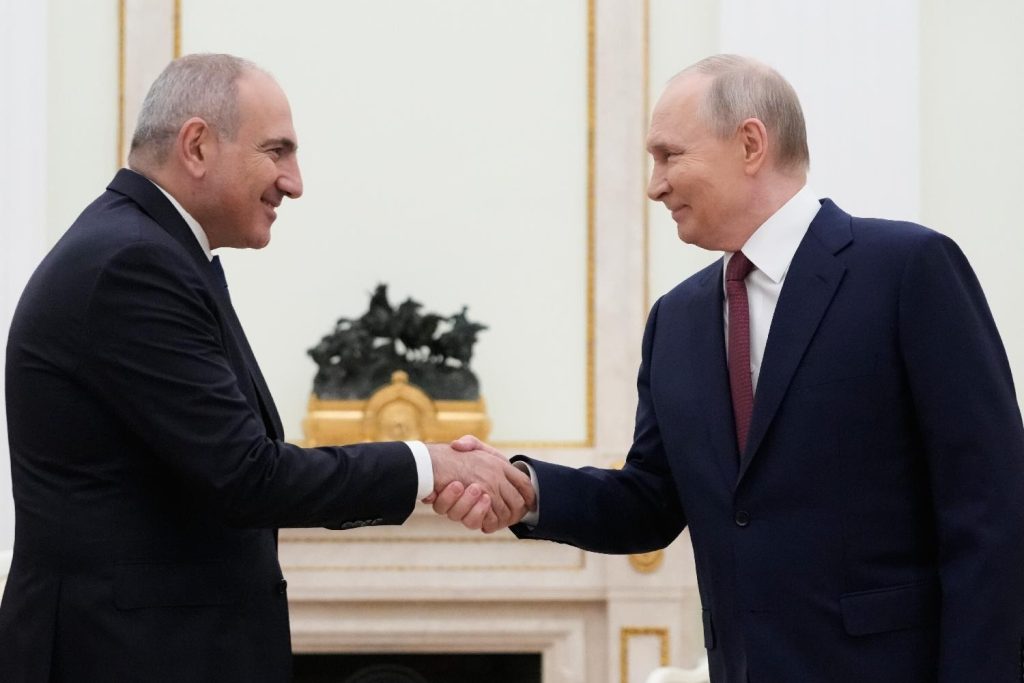
Russian trade’s threats: Is Armenia the new battleground between Eastern and Western influence?
A few days before the Armenian parliamentary elections on the 7th of June 2026, Russia has been intensifying its trade restrictions and economic threats towards the country.
After two mandates, the centrist Prime Minister Nikol Pashinyan led the parliamentary elections polls as well as its preliminary results despite Russian pressure, indicating his likely pursuit as a pro-EU head of the government of Armenia.
Pashinyan’s political choices to diversify its trading partners, through partnerships with UAE, Azerbaijan and China, and strengthen ideological ties with the EU led to Russia’s firm decision to stop importing some strategic Armenian products. This could deeply affect the economic situation of Armenia for which Russia is essential.
The end of Russia-Armenia strategic and historical partnership?
Nowadays economic and ideological tensions are particularly marked by a history of close ties between the former members of the Russian Empire and USSR, Armenia and Russia.
Since its independence in 1991, Armenia notably signed around 250 agreements with Russia on fields including politics and military and was one of the first States to join the Russia led Commonwealth of Independent States (CIS), the Collective Security Treaty Organisation (CSTO) military alliance, as well as the Eurasian Economic Union (EAEU) in 2015.
A great military and diplomatic ally during the Nagorno-Karabakh war between Armenia and Azerbaijan since the 1990s, the situation reversed when Russia didn’t back Armenia against Azerbaijan in 2023. This contributed to fuel a feeling of abandonment in Armenia and pushed its government to develop new strategic alliances, especially with Western States. Those include Armenia’s adhesion to International Criminal Court (ICC) in 2024, forbidding Putin to set foot in the country, as well as its “de facto” withdrawal from CSTO and more recently its diplomatic partnerships with EU Member-States.
Russia: one of Armenia’s biggest trade partners
In 2025, Armenia imported 7.7 B $ of goods from Russia, which is 5 B less than in 2024 but still almost two times the worth of total imports from the EU. Russia is also the second country with which Armenia exports the most, with a total of 3.14 B $ in 2024. As such, the economic threats and sanctions announced by Russia could be cause for concern for the country. These include, in particular:
- threats to cut Russian oil and gas supplies, which represents 80% of Armenian gas and oil imports
- threats to expel Armenia from the Eurasian Economic Union (EAEU), possibly increasing fuel price
- the restriction of Armenian imports in Russia on major goods sectors such as wine, brandy, mineral water, fresh fruit and vegetables, flowers and fish.
Can Armenia economically succeed without Russia?
Nikol Pashinyan yet multiplied trade partnerships during his part mandates which could limit the effect of Russian pressures:
- Armenia and UAE recently signed a trade agreement on trade in services and mutual investment strengthening their economic relations. Their trade activities notably increased by 60% from 2024 to 2025.
- While introducing the establishment peace treaty between Armenia and Azerbaijan which still has to be signed and ratified, Donald Trump aims to rally both States to its so-called “Trump Route for International Peace and Prosperity” (TRIPP) project. This could largely increase economic bounds between all countries sus-mentionned.
- Armenia also shares strong economic partnerships with China, especially since a 2025 agreement supposed to strengthen trade, investment and technological cooperation between them.
- Finally, since the beginning of Russian threats and pressures in May 2026, the EU officially announced supporting the Armenian economy through a €50 million loan and concrete measures to maintain Armenian trade such as the buying up of certain strategic products by some EU Member-States.
The Armenia-EU summit: a move towards European values
Over the past month, Nikol Pashinyan also intensified his diplomatic interactions with EU officials such as the President of the European Council Antonio Costa or the President of the European Commission Ursula Von Der Leyen through the first ever Armenia-EU summit the 4th and 5th of May 2026. This political move aims, as the Armenian Prime Minister wrote himself on his X account, to “reaffir[m] our shared resolve towards democracy, peace & better future for our citizens”.
Even though EU-Armenia relations preexisted, notably through the EU-Armenia Comprehensive and Enhanced Partnership Agreement (CEPA) since 2021, this summit, which welcomed many officials like British PM Keir Steimer and Spanish PM Pedro Sanchez or Ukrainian President Volodymyr Zelensky, represent a concrete shift for the country towards western values.
Even though not officially politically affiliated, those trade disruptions started by Russia happened right after this political bridging. The economical and political consequences of those strategies are hard to tell yet, but some commenters considered those elections to be central to Armenian’s choice to choose one side over the other. After the primary results of the legislative elections, which granted him almost 50% of the votes, Nikol Pashinyan however ensured that “[They] will continue the course of rapprochement with the West, but [They] will also continue [their] participation and membership inArmenia’s pro-West government wins election despite Russian pressure the Eurasian Economic Union”.