
The government’s propaganda architecture in Serbia: Who’s who in Vučić’s ensemble?
In the Serbian president’s chess game with public perception, every player knows their role. The production of smoke and spin relies on a well-rehearsed “ensemble” drawn from the political leadership, media employees, on-call experts, and cultural figures. At the center stands Aleksandar Vučić, supreme narrator, moral authority, and savior.
The Serbian public, exhausted by crises both genuine and staged, has been subjected to years of narratives about success and a golden age. The hero of the economic tiger fairy tale needs enemies, both domestic and foreign, in order to play the role of the caring and effective leader.
Domestic propaganda is not necessarily focused on persuasion, but on managing public emotions and sustaining a sense of constant threat. When necessary, Aleksandar Vučić distances himself from certain segments of the ensemble and its narratives, particularly when they risk damaging his image before the international community.
However, this distancing is merely a simulation of detachment. While projecting the image of a “moderate” leader externally, he internally maintains a network of radical voices that exist, perform, and shape public opinion thanks to him.
At the height of Serbia’s political crisis in 2025, our study* mapped 54 actors. Each of the 54 is assigned specific themes, amplifies them, or validates them.
In short, closely tied to the political elite and the highest levels of power, this network operates through clearly defined roles, recycles a stable set of eight dominant narratives, and follows a predictable communication rhythm aligned with current political events.
Who’s who?
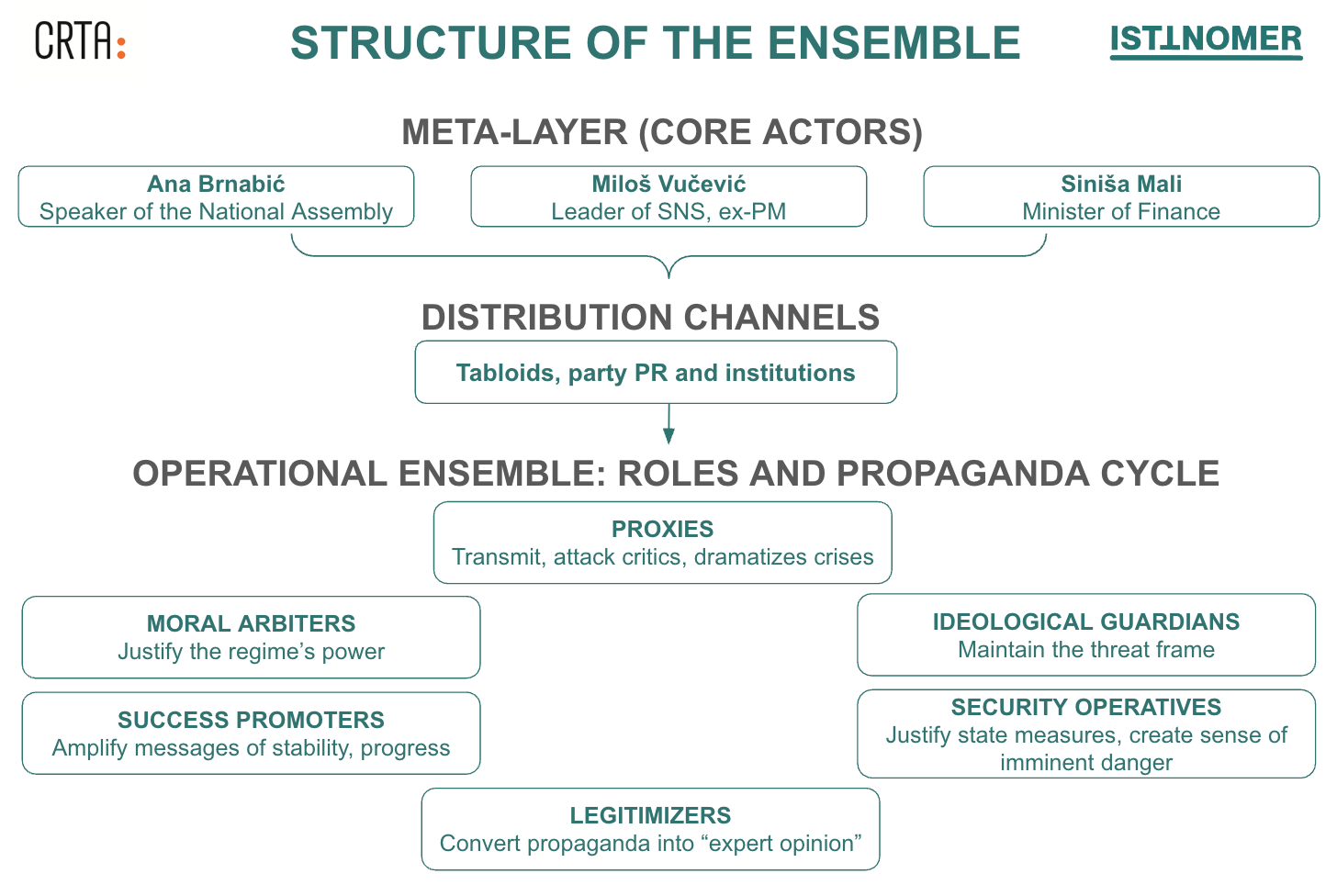
At the apex of the communication pyramid stand Ana Brnabić, Miloš Vučević, and Siniša Mali. They form the core that carries the regime’s dominant messages.
Brnabić is Vučić’s first line of defense. Her tasks are to attack dissenters and critics of the regime, to engage in extreme glorification and victimization of Aleksandar Vučić, and to remind the public that Vučić is the epicenter of success and stability.
Vučević sustains a state-building and “soft” nationalist discourse, introduces nationalist messaging, and deepens polarization. Siniša Mali speaks of success and stability, affirming Vučić specifically through economic achievements.
**“The operatives” are political functionaries and party actors, analysts and experts from quasi-independent centers, institutes, and organizations close to the government. They also include professors and academics, editors, journalists and television hosts, as well as security and para-intelligence personnel. Artists, cultural figures, and businesspeople also fall into this group. The regime invests most heavily in those who appear “expert” and “neutral,” since it is precisely through them that the propaganda message is disguised as a depoliticized stance.
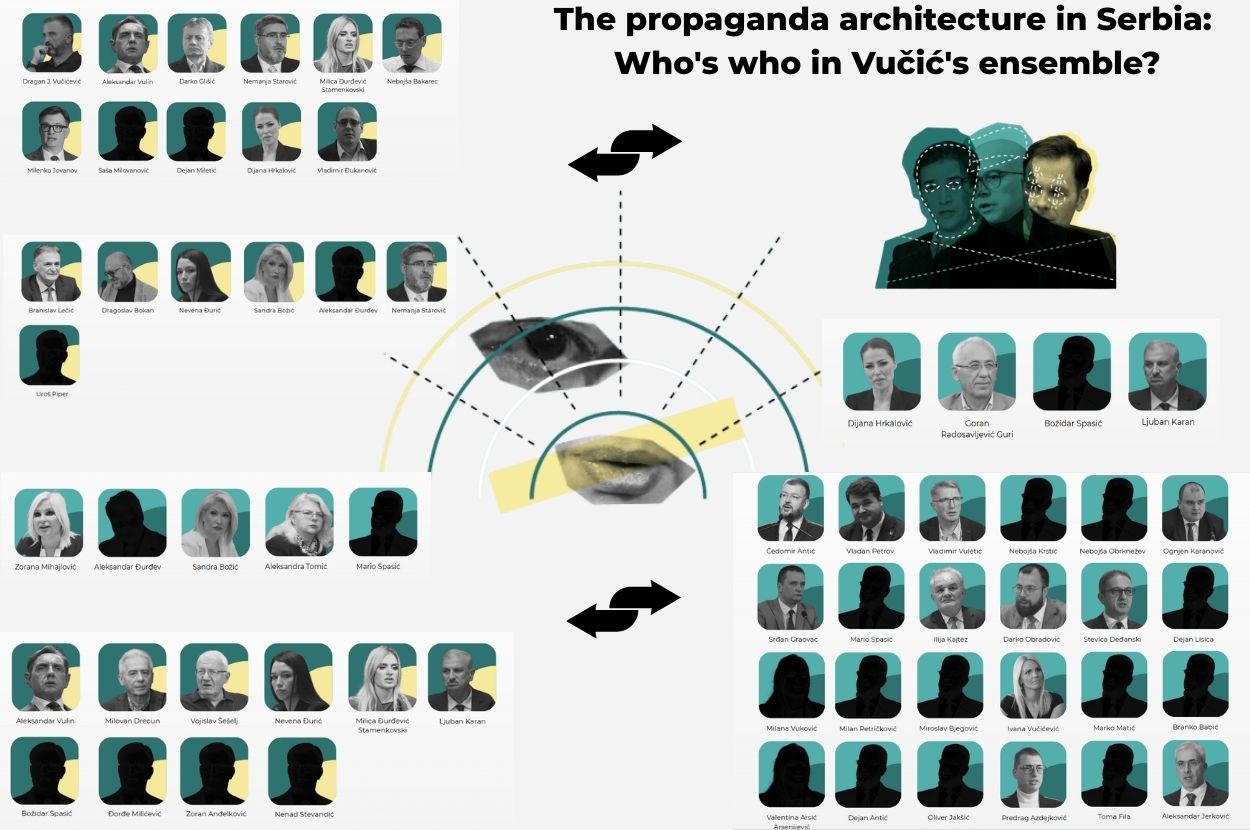
“Spokespeople” or “proxies” relay key messages and set the tone. They most frequently employ disqualification, dramatization, and defensive narratives.
Among them are: Dragan J. Vučićević, Darko Glišić, Milenko Jovanov, Vladimir Đukanović, Nebojša Bakarec, Saša Milovanović, Dejan Miletić, Aleksandar Vulin, Milica Đurđević Stamenkovski, Dijana Hrkalović, and Nemanja Starović.
During our research period, from January to June 2025, these actors were responsible for narratives about attacks on the state and the president, violent protests, and internal enemies.
“Legitimizers” provide “expert” and analytical justification for regime positions. They explain the government’s moves in the language of science, security, law, and morality.
In this role are Čedomir Antić, Vladan Petrov, Vladimir Vuletić, Milan Petričković, Miroslav Bjegović, Ognjen Karanović, Srđan Graovac, Mario Spasić, Ilija Kajtez, Darko Obradović, Stevica Deđanski, Dejan Lisica, Milana Vuković, Nebojša Krstić, Nebojša Obrknežev, Ivana Vučićević, Marko Matić, Branko Babić, Predrag Azdejković, Toma Fila, Aleksandar Jerković, Oliver Jakšić, Dejan Antić, Valentina Arsić Arsenijević.
The messages delivered by legitimizers consistently held that the state is stable and responsible and that all those opposed to the government are opposed to the state.
“Ideological guardians” maintain narratives of threat, link domestic and foreign dangers, and call for unity and loyalty. Prominent ideological guardians include Aleksandar Vulin, Milovan Drecun, Vojislav Šešelj, Nevena Đurić, Ljuban Karan, Božidar Spasić, Milica Đurđević Stamenkovski, Đorđe Milićević, Zoran Anđelković, Nenad Stevandić. They are the ones who sustain the narrative that the Serbian people must unite, that Serbia is under attack.
“Promoters of success” maintain the narrative of stability, economic achievement, and the “golden age.”
The standard-bearers of the “golden age” are Zorana Mihajlović, Aleksandar Đurđev, Sandra Božić, Aleksandra Tomić, and Mario Spasić. Their statements consistently feature the message of a Serbia being built, a state stronger than ever.
“Moral arbiters” justify the regime through moral, religious, and traditional values, condemning “violence” and “betrayal” through value judgments and propagating the narrative of a decent, normal Serbia in contrast to thugs and enemies of the state. In this role are Branislav Lečić, Dragoslav Bokan, Nevena Đurić, Sandra Božić (in a secondary capacity), Aleksandar Đurđev, Nemanja Starović, Uroš Piper.
“Security operatives” produce narratives around order, law, institutions, and the state’s response. They invoke the institutional framework and security dimensions, justify state measures, and generate a sense of threat. Dijana Hrkalović, Goran Radosavljević Guri, Ljuban Karan, and Božidar Spasić focus their appearances and statements on how the state is responding, that destabilization has been prevented, that attacks on institutions are ongoing, and that the constitutional order is under threat.
***
The analysis covers 51 actors (54, if Brnabić, Mali, and Vučević are counted in their separate role as “grand viziers“) who appear most frequently in the discourse monitoring of pro-government media, based on continuous tracking data (Istinomer). They form the core of the propaganda communication network, whose messages during the observed period (January-July 2025) were the most visible, most coordinated, and most influential.
The structure encompasses political functionaries, analysts, professors, media and security figures, as well as cultural and symbolic authorities – making the institutionally and socially embedded nature of the propaganda ensemble unmistakably clear. Beyond this core, there is a broader group of actors who participate in the network on an occasional basis, taking on specific roles as needed.
The main narrative framework: Danger from within, wanger from without
This study was conducted at the height of Serbia’s crisis, from January to June 2025, when the propaganda network was reaching peak activity. The central image of reality ,”danger from without, danger from within”, spreads through two dominant directions: the delegitimization of the opposition and civic initiatives, and the moral justification of the government and the president.
The intensification of crisis narratives in March and June points to coordinated communication during periods of political tension. Affirmative discourse (“the golden age,” “Vučić as savior”) strengthens during de-escalation phases.
The dominant narrative across all months concerns internal enemies (the opposition, critics, NGOs). It is the most widespread in the entire communication network, present in the output of 49 of the 51 analyzed actors (or 54, counting Brnabić, Vučević, and Mali). The leading actors portray the opposition, non-governmental organizations, and critical public voices as threats to state stability. The narrative’s purpose is to neutralize criticism and redirect public attention away from government accountability toward “internal enemies”, thereby recasting criticism of the government as an attack on the state itself, while positioning the ruling structure as its defender.
“The protests are violent” is a narrative recorded among 37 actors. It functions to delegitimize civic discontent and control public perception of the protests, while also justifying the government’s repressive policies. Its core function is to frame protests as a threat to state stability rather than as an expression of political dissent, redirecting public attention from the causes of the protests to their consequences. Vučević is particularly prominent in constructing this narrative.
“The Serbian people must unite because we are under threat”, the “national unity” narrative, recorded among 28 actors serves a mobilizing and stabilizing function. It calls for the people to rally around the government and the president in “difficult times,” and is deployed in response to domestic crises and external pressures, effectively neutralizing pluralism and framing any criticism as divisive and weakening to the state. The phrase “the Serbian world” is most closely associated with Aleksandar Vulin.
“Foreign enemies are destroying Serbia” is a narrative identified among 25 actors during the observed period. It constructs an image of Serbia as a “besieged fortress,” a victim of foreign interference and Western pressure, serving to homogenize the electorate and justify authoritarian policies. Vulin and Šešelj in particular emphasize the danger from “foreign centers of power,” while tabloid media amplify the tone of threat and geopolitical conflict.
The “golden age” narrative, identified among 21 actors, represents the positive propaganda framework through which the government builds an image of a successful and stable Serbia. The emphasis on economic and infrastructure achievements serves to “soften” crises. Siniša Mali plays a particular role in shaping and disseminating messages about Serbia’s progress, while select actors lend additional support to the narrative through their statements.
The “color revolution” narrative, recorded among 18 actors, is used for the preemptive delegitimization of protests and civic initiatives. Criticism of the government is interpreted as part of a foreign scenario to destabilize Serbia, thereby justifying heightened control and repression. Among the most prominent actors, a high volume of statements glorifying Aleksandar Vučić is clearly discernible.
The moral superiority of the government and Aleksandar Vučić is a narrative recorded in the statements of 15 actors. It presents the government as morally superior and motivated by “good intentions” relative to the opposition and its critics. Through the use of religious and ethical motifs, the government is cast as a suffering party that perseveres for the sake of the people, while opponents are portrayed as “corrupt” and “immoral.” Milenko Jovanov is particularly articulate in delivering these messages within the discourse framing the opposition as the antithesis of morality. The narrative’s goal is the emotional mobilization of voters and the preservation of the government’s image as a “moral authority.”
“Vučić as savior and rational leader” is a narrative identified among 12 actors. It represents the personalized center of the propaganda system. The president is portrayed as a rational leader and protector of the state who “saves Serbia from crises” and maintains stability. Glišić, Jovanov, Božić, and Đurić give the narrative its institutional form, while Brnabić holds primacy in spreading and amplifying the narratives that glorify Aleksandar Vučić.
The cycle of crisis and controlled tension
The analyzed period reveals a complete cycle of reactive propaganda: crisis → mobilization → moral reconstruction → heroization of the leader → new crisis — a cycle through which the regime maintains controlled tension and directs public opinion, effectively controlling the meaning of reality.
All identified major narratives almost never appear in isolation, but are part of larger narrative frameworks: (1) Vučić, as guarantor of Serbia’s stability, progress, and sovereignty, is always a target of enemies; (2) Serbia is under threat from internal and external enemies; (3) the protests are violent attempts at a color revolution.
These frameworks represent three lines of defense for the government: defense and glorification of the leader; confrontation with political opponents and dissenters; and centralized responses to crisis.
Aleksandar Vučić is the epicenter of all narratives.
In the transmission and amplification of the propaganda network’s key messages, the outlets Informer, Kurir, Pink, Alo!, Novosti, Politika, and Tanjug stand out in particular. Informer, Novosti, and Alo! very frequently and synchronously publish near-identical articles and headlines within short timeframes.
Propaganda in Serbia: A mechanism that sustains constant tension and the illusion of threat
The analysis of the government’s communication network reveals a hierarchical and highly coordinated propaganda system. This model demonstrates that propaganda in Serbia is not a spontaneous response to crisis, but an institutionalized communication mechanism that sustains constant tension and the illusion of threat.
The regime does not propagate ideas, it maintains a controlled crisis. Every phase of communication is designed to produce fear, polarization, and ultimately stabilization through the figure of the leader. The greatest investment goes into the legitimizers. The government depends on “expert,” “analytical,” and “academic” voices to transform its messages into rational and moral justification. By creating para-formations, it seeks to legitimize itself and simulate “independent opinion.”
Spokespeople and tabloids generate noise, but it is the legitimizers who supply meaning. That indispensable external validation, delivered through staged authorities, is a hallmark of a regime no longer confident in its own legitimacy. Domestic propaganda is highly reactive, functioning as a response to every perceived threat, political, social, or symbolic, thereby revealing a persistent fear of losing control.
The relationship between Aleksandar Vučić and the ensemble – an echo chamber
The ensemble is a propaganda mechanism that Vučić uses to shape, manipulate, and anesthetize public opinion, through intimidation, deception, and ultimately the demotivation of citizens from participating in political life.
Vučić empowers the actors in the ensemble to launch, spread, and amplify narratives that reinforce his position: they consolidate his voter base, drive dissenters away from politics, and normalize repression and the demonization of opponents. The dynamic between the ensemble and Vučić functions as a two-way echo chamber. Top-down: the president formulates the framework; the ensemble amplifies it and “packages” it for different audiences: patriotic, “expert,” international. Bottom-up: proxies launch trial balloons, often radical in tone; Vučić then selects which motifs to adopt and incorporate into his own narrative, ultimately elevating them to official state positions.

Judge, prophet, personification of the state
Aleksandar Vučić is the interpreter of reality, the “judge” and “prophet” of events, the personification of the state. He decides what is merely a “media story” and what becomes state policy. As supreme narrator, he filters what is intended for the domestic audience and electorate, and what is destined for the international community.
Vučić is the director of his ensemble. He sets the framework, themes, and tone; he frames motifs for the public, assigning meaning and significance. When necessary, he distances himself from certain segments of the ensemble and its narratives, particularly when they risk damaging his image before the international community. Yet this distancing is merely a simulation of detachment: externally, he projects the image of a “moderate” leader; internally, he maintains a network of radical voices that exist, perform, and shape public opinion thanks to him.
The propaganda network combines three spheres of influence: the political (party functionaries and ministers, who institutionalize narratives), the media (editors and journalists, who distribute and amplify), and the analytical-academic (professors, historians, analysts, who rationalize).
Their number and frequency demonstrate that during the observed period the propaganda system sought to secure rational and moral legitimacy for regime messaging, particularly during de-escalation phases (April–May). The regime invests most heavily in those who appear “expert” and “neutral,” since it is precisely through them that the propaganda message is transformed into social fact. The high representation of professors, analysts, and cultural figures may also indicate that the regime feels its legitimacy cracks most acutely in precisely those strata.
The communication network operates through a clear vertical structure consisting of a meta-layer (Brnabić — Speaker of the National Assembly and former Prime Minister; Vučević — President of the Serbian Progressive Party and former Prime Minister; Mali — First Deputy Prime Minister and Minister of Finance), an operative ensemble, and media amplifiers.
Messages flow from the top, where strategic frameworks are defined, down to operative actors who distribute, escalate, or moderate narratives. This demonstrates that the propaganda is institutionalized, not spontaneous.
Eight dominant narratives are continuously recycled over the course of the past year, and the propaganda operates through six functional roles that collectively produce and legitimize regime messages, functioning as a coordinated ensemble that ensures message coherence across the political, professional, and media spheres. Aleksandar Vučić is the central narrative generator and ultimate arbiter of meaning. All narratives ultimately concentrate on the person of the president, who acts as primary narrator, moral authority, and “legitimacy filter.” He selects which narratives produced by the ensemble become official and reshapes messages for domestic and international audiences.
The system thus forms a two-way echo chamber between the leader and the ensemble. Operative ensemble members frequently introduce more radical messages, which are then tested in the public sphere. Vučić subsequently decides which messages to adopt, legitimize, or moderate.
Propaganda follows a cyclical, crisis-driven rhythm aligned with political events. The January–July chronology reveals a distinctly structured communication cycle. Escalation phases (March, June) are marked by sharp spikes in narratives about violent protests, internal and external enemies, and destabilization. De-escalation phases (April, May) are characterized by a rise in moral and affirmative narratives (“the golden age,” “Vučić as the voice of reason”).
Peaks of narrative intensity correspond to politically sensitive dates and moments of public mobilization March 7–15 and June 20–30, coinciding with major protests, institutional crises, and significant security developments. Periods of lower intensity correspond to windows of political stabilization (April 1–10; May 15–30). This alignment demonstrates a direct link between political crises and the activation of narratives.
The ensemble operates across media, politics, academia, culture, and security, forming a multi-sector propaganda architecture. The system encompasses 51 actors (beyond the three in the role of grand viziers), demonstrating that propaganda is not merely a media phenomenon but a governing tool embedded in state, party, professional, and cultural infrastructures.
***
This English translation was generated with the assistance of AI and reviewed for accuracy.
** Story updated on February 23, 2026.
Methodology
Period of analysis: January–June 2025, intentionally selected to examine the dynamics of narrative distribution in the lead-up to significant socio-political events that followed November 1 (in particular, ahead of the major protest of June 28).
Analytical sample: 54 actors analyzed, with a total of 1,238 recorded public communications (statements, appearances, commentary).
Selection of actors: Actors were identified in the first phase of the research, when the team mapped the most frequent and most influential actors in shaping public discourse.
Data collection: Conducted via advanced Google search, with systematization by publication date, media source, and message content.
Analytical framework: The following were examined: actors and their roles; the temporal distribution of messages; and dominant narratives in the media space.
Objective of the analysis: To determine who originates and transmits messages; how and through which media they are disseminated; and the degree to which the communication network is centralized, coordinated, and orchestrated.
The analysis is based on a list of 54 actors defined by Istinomer, drawn from continuous monitoring of participants in regime discourse. Individuals were selected on the basis of: (1) frequency of media appearances and public performances; (2) the significance of the messages and narratives they initiated or actively supported in public discourse; (3) their institutional or political position and influence on decision-making; (4) their role in amplifying key messages across various communication channels (traditional and digital media); and (5) the continuity and consistency of their advocacy for specific narrative frameworks.
The three most prominent political figures (Brnabić, Vučević, Mali) were observed in isolation from the remaining actors.
Within this study, the period from January to July 2025 was covered. For each actor, statements were collected via advanced Google search, then systematized and coded according to thematic and narrative frameworks.
A limitation of the sample is that only messages carried by online portals were analyzed, rather than all public appearances by the actors (broadcasts, press conferences, etc.).
Authors: Research team of Crta and Istinomer