
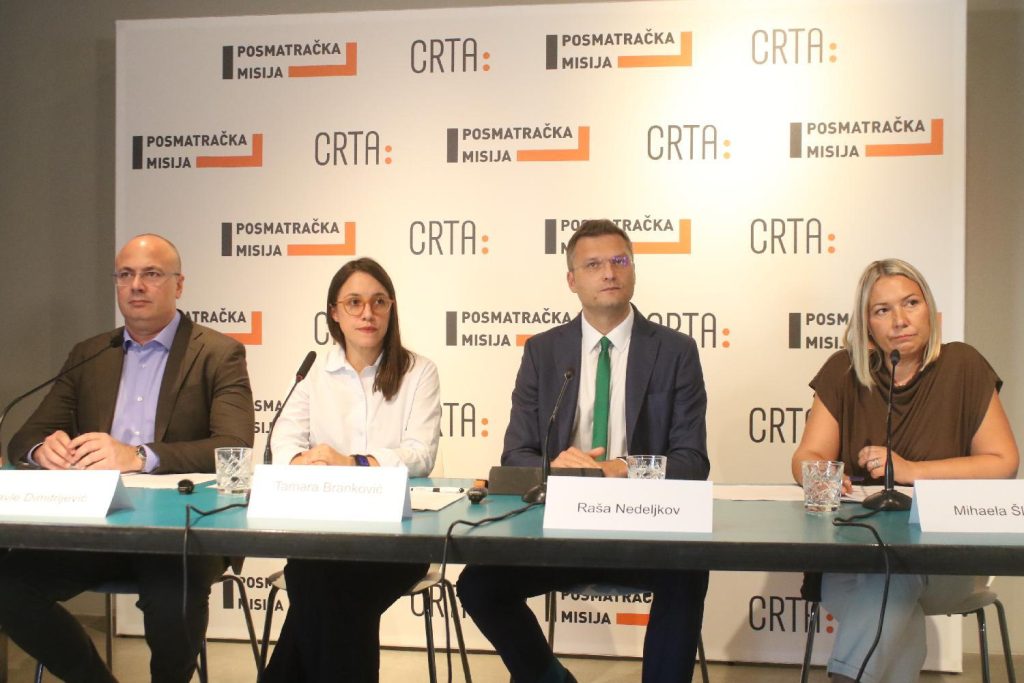
CRTA Election Observation Mission: First Part of the Campaign Marked by Threats to Citizens’ Rights and Freedoms
CRTA’s Election Observation Mission has presented a report on its monitoring of the first part of the pre-election campaign. The report highlights serious problems already emerging during the campaign, including the use of highly intrusive spyware to monitor opposition figures and the prevention of nearly 22,000 voters from exercising their right to vote.
The first part of the report states that opposition figures have been subjected to unlawful wiretapping and police operations that give rise to suspicions of political motivation. The frequency of incidents — 49 recorded during the first three weeks of the campaign — has been accompanied by manipulative messages from political actors and the media about alleged plans to provoke unrest and overthrow the constitutional order.
The report warns that approximately 22,000 voters will be unable to exercise their right to vote as a result of what CRTA’s Election Observation Mission describes as an inadequately justified decision by the Ministry of Foreign Affairs not to open polling stations in cities where a sufficient number of voters had registered. Voters living abroad have faced an additional obstacle following what CRTA describes as an unprecedented decision to conduct voting across all time zones according to Serbian local time.
The media were also included in the monitoring. According to the report, the most influential pro-government online media outlets published nearly 1,500 items during the period under review warning of potential chaos and violence on election day. On average, seven articles per day characterised the activities of opposition figures as a “colour revolution”.
There is also a pronounced disparity in media coverage of the ruling parties and the opposition.
The opposition as a whole received half as much airtime as the ruling parties, while almost every second of its broadcast coverage was presented in a negative tone. The opposition received the least airtime on Radio Television of Serbia (RTS), accounting for just 15 per cent of the total time allocated to all political actors. According to CRTA’s Election Observation Mission, even this limited share was largely the result of the introduction of mandatory election-related programming blocks.
The electoral process itself has been under threat from the outset.
According to the report, there are well-founded suspicions concerning the candidate nomination process, alongside indications that citizens have been subjected to pressure to support particular electoral lists.
The “Aleksandar Vučić – United Serbia” electoral list was involved in numerous questionable activities. According to the report, one in every three activities associated with the list was problematic.
Activities documented in the field reportedly included elements of manipulation or abuse of the law. These ranged from suspicions that signatures of support had been falsified or certified in the absence of the citizens concerned, to cases involving the potential misuse of public resources and public office that blurred the distinction between the state and the political party.
The report also identifies suspicions of attempts to circumvent campaign-financing rules by offering money, assistance or employment in exchange for political support, as well as making employment, income and access to public services conditional on such support.
The report also highlights problematic conduct by the Regulatory Authority for Electronic Media (REM) and the Agency for the Prevention of Corruption. According to the report, these institutions contributed to the ruling party’s advantage by failing to enforce the law consistently, through both their actions and their inaction.
The report emphasises that the promotion of hostility towards independent, civil society election observers has become a matter of everyday concern. It also recalls that, immediately after CRTA submitted its resignation, Aleksandar Vučić referred to the organisation as the “worst participant in the colour revolution”.