
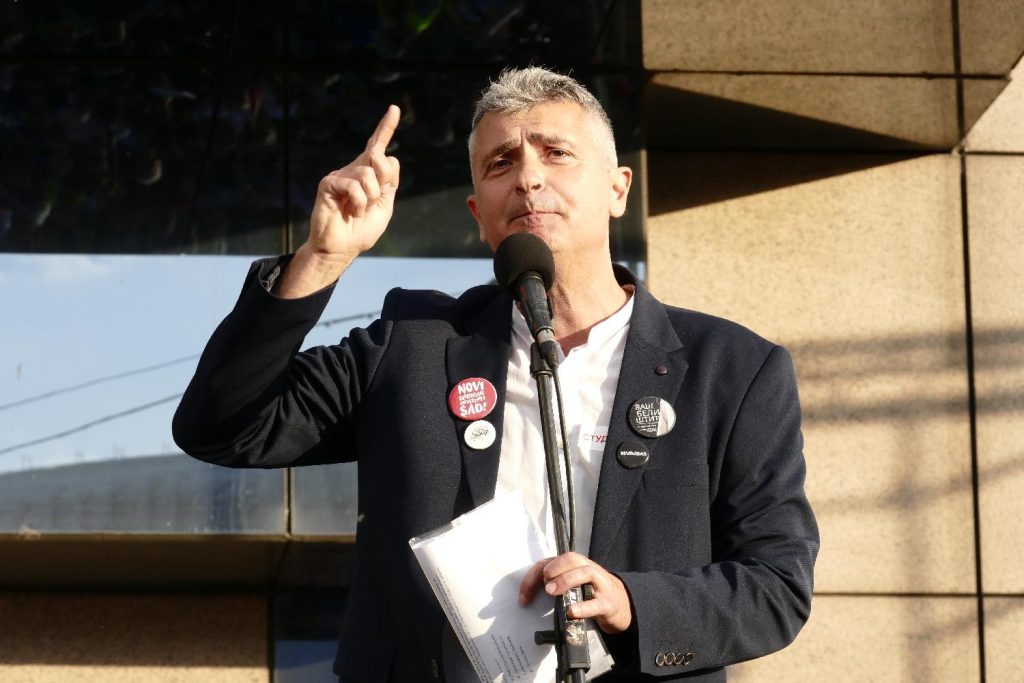
From the “Fake Student List” to “Milo’s Doctor”: How Ilija Srdanović Became the Target of Media Attacks
From the moment the Student List submitted its list of candidates for the upcoming elections, pro-government media launched a wave of attempts to discredit it. Ilija Srdanović, the lead candidate on the list, soon became the main target of these attacks. He was accused of violence and of targeting students, of alleged ties to the Serbian Progressive Party (SNS) and Montenegrin separatism, of being “Milo’s man,” and of having structures from Montenegro and Croatia behind him. Some of these claims were based on digitally manipulated photographs, while no evidence was provided for others.
The “Student List – Students Win” submitted its list of candidates for the National Assembly to the Republic Electoral Commission on September 14. Immediately afterwards, the students published the full list of 250 candidates, headed by cardiologist and professor at the Faculty of Medicine in Novi Sad Ilija Srdanović.
That same day, several pro-government media outlets published articles challenging the list and its candidates. “Fake Students’ List” and “opposition fraud”, “political amateurism”, “they want to run the country but forgot the most important document”, and “just an ordinary gathering of idiots” were just some of the labels used.
A narrative also emerged that the list was not actually a student list, but that opposition figures were behind it, specifically Bojan Pajtić. Informer, referring to an alleged admission by Pajtić, reported that he had “admitted” to being the “informal leader and commander” of the list, claiming that the “former leading figure of the Yellow regime has announced a new burning and looting of Serbia.”
Several hours later, President Aleksandar Vučić made a similar claim. He said that Bojan Pajtić and Dušan Petrović were behind the leaders of the Student List, describing the candidates on the list as Pajtić’s “ideological followers.” Vučić also said that it was a “mass without an ideology,” with no plan or programme. The Student List was subsequently given the derogatory name “Pajtić’s Blockaders’ List” in pro-government media.
At the same time, an old narrative was revived claiming that Croatia was allegedly behind the students. The main message was that “Croats are hoping for blood in the streets of Serbia” and that “Croatia supports and finances most of the blockaders’ actions.”
The campaign to discredit the list continued the following day, again with the claim that it was not a student list because of the candidates’ ages. “Student List without students, with an average age of 50.6” and “They are 1,750 years older than Vučić’s list” were among the headlines published by several media outlets. The electoral lists published by the Republic Electoral Commission, however, do not include candidates’ years of birth. The articles publishing figures on the candidates’ average age did not explain what data those calculations were based on.
Srdanović Targeted in 247 Articles
In just four days, from September 14 to 18, 748 articles about the Student List and its candidates were published by seven news portals, and only 20 of them contained no claims aimed at discrediting the list or its members. Srdanović was directly targeted in 247 articles, meaning that practically every third article included in the analysis contained an attack directed personally at him, according to the findings of CRTA’s media monitoring.
Thus, within the first two days after the list was submitted, several key narratives emerged: questioning its student character, portraying the list as incompetent and disorganized, claiming that opposition structures were behind it, and promoting the narrative of alleged Croatian involvement.
Srdanović as a “Violent Man” and a Professor Who “Targets” Students
While the attacks on the first day were mainly directed at the Student List as a whole, from September 15 the focus increasingly shifted to its leader, who became the main target of attacks and attempts at discrediting him.
The first layer of the attacks concerned Srdanović’s personality and professional integrity. The media portrayed him as a person with unacceptable behaviour, as a “violent man,” but also as someone who violated workplace rules.
Alo published an article making serious and unverified allegations, claiming that he was “a man who beats women” and “a violent man who even threw a printer at his female colleagues.” Other pro-government media outlets immediately began repeating the claims. “Known for violence”, “The violent man who beat women”, “The so-called ‘Students’ List’ is led by a doctor accused of violent behaviour”, and “The man who beats women” were just some of the headlines.
He was also accused of “violating work obligations and disciplinary offences”, of “organising parties” at the Clinical Centre of Vojvodina during COVID, of being a “strong sympathiser and supporter of the SNS”, as well as of having “been in the SNS until 2020”. The articles did not provide evidence for these claims.
A second pattern of attacks called into question Srdanović’s relationship with the students he taught. Several media outlets reported that Srdanović had allegedly targeted his own students, who, it was claimed, “wanted to study rather than participate in political confrontations.”
As “evidence,” a Viber group chat was published, allegedly showing that Srdanović had “posted a list of 11 students” from the student parliament of the Faculty of Medicine at the University of Novi Sad. The main message was: “If Srdanović behaved this way towards his own students, what would he do to people who disagree with him if he happened to come to power?”
From a Montenegrin to “Milo’s Doctor”
The third and considerably broader narrative concerned Srdanović’s alleged political and national disloyalty to Serbia. The media linked him to Montenegrin separatism, the Democratic Party of Socialists of Montenegro (DPS), and Milo Đukanović. Manipulated photographs were also used in the attempts to discredit him.
A claim was circulated that, in the most recent census, Srdanović had allegedly declared himself to be a Montenegrin, and that at a “blockaders’ rally” he had allegedly displayed “extremist symbols.”
Republika, a portal owned by Srpski telegraf, published a photograph of Srdanović in which he appeared to be forming the letter “L” with the fingers of his right hand. It was a gesture that, according to the article, had “remained recognizable as a Montenegrin pro-sovereignty, or pro-independence, symbol, particularly among supporters of Montenegrin independence.”
The photograph, however, was not authentic in the part showing Srdanović’s right hand. As we have already reported, in the original photograph, taken on September 10, 2026, at the first campaign rally of the Student List in Novi Sad, Srdanović is holding his right hand up in a clenched fist, rather than forming the letter “L.”
Several pro-government portals simultaneously reported on support from Montenegro that Srdanović received from former Montenegrin foreign minister Miodrag Vlahović. The main narrative was that “Montenegro’s greatest hater of Serbia” and “greatest Montenegrin separatist” had supported Srdanović, thereby “publicly supported the overthrow of the government in Serbia”, and that “Montenegrin separatists want to destroy Serbia”
Ilija Srdanović was eventually labelled “Milo’s man.” Several media outlets thus claimed that he had, “with strong and unequivocal support for Montenegrin secession and the same kind of support for the country’s then-leader Milo Đukanović, with the same fervour, also advocated Montenegro’s accession to NATO,” which, according to these reports, “would spill over into Serbia as soon as he got the opportunity.”
The Montenegrin narrative then acquired a new dimension. Srdanović was no longer portrayed merely as politically close to Đukanović, but as someone connected to criminal circles.
The culmination of this portrayal was an alleged Sky ECC exchange of messages, published by Dragan Vučićević, the owner and editor-in-chief of Informer. The messages allegedly came from Vesna Medenica, former president of the Supreme Court of Montenegro and mother of Miloš Medenica, who has been sentenced at first instance and is the subject of an arrest warrant.
According to Vučićević, the alleged exchange of messages “proves” that Ilija Srdanović is “a man personally trusted by Milo.” In a message allegedly dated March 22, 2022, Vesna Medenica supposedly wrote that she planned to go to Serbia because “there’s some doctor there who treats Milo, Srdanović, one of ours whom we trust.”
There is, however, no evidence that the message is authentic. The date of the alleged message presents an additional problem, since the encrypted communications platform Sky was shut down in March 2021.
Despite this, several media outlets (Alo, Politika, Kurir, B92, Novosti) repeated Vučićević’s claims that the head of the Student List was “Milo’s doctor.” Srdanović was asked about the nature of his “relations with former criminal and state structures in Montenegro,” and it was claimed that it was now clear that “all of this is the plan of Bojan Pajtić, Dušan Petrović and Nenad Čanak to overthrow Serbia.”
A narrative was then promoted according to which Milo Đukanović was “interfering in Serbia’s elections through Srdanović and taking revenge on Vučić for his fight against the clans.”
The day after these headlines appeared, on September 18, Serbian President Aleksandar Vučić said: “As for the rest, everything that is written about that communication is true.”
That same day, several media outlets published a photograph taken from Instagram showing a group of young men with Montenegrin flags. While Politika reported that the photograph had been taken in Lovćenac in the late 1990s, Kurir claimed that it had been taken on Mount Lovćen and that Srdanović could be seen “proudly displaying the L sign.” The headline in Kurir read: “Ilija Srdanović with a Montenegrin flag, hand forming the letter ‘L’ for the liberals! The first candidate on the blockaders’ list in Serbia was rooting for an independent Montenegro back in the ’90s.”
The photograph, however, was digitally manipulated. The original photograph was published in October 2002 in the weekly magazine Vreme, as part of an article entitled “Milo, Still.” In the original photograph, the young man alleged to be Srdanović looks completely different.
At the same time, Srdanović was placed within a broader narrative about Serbia’s external enemies. Following the claims about links to Montenegrin structures, pro-government media began reporting on an “attack on Serbia” from Croatia.
An example of coordinated reporting appeared on September 18, when several media outlets almost simultaneously introduced the claim that Croatian media were conducting a campaign in support of Srdanović and the Student List. Allegations were made that Srdanović had “also been in cahoots with Croats, with veterans of the ‘Homeland War,’” that he was a “hero in Croatia,” and that “the blockaders and Croats have long been on the same mission: to bring down Serbia and Vučić,” while it was also reported that “Croats are openly campaigning for Ilija Srdanović.” There were also references to “Ustasha support”.
Following a similar logic, Srdanović was also linked to people whom the government and pro-government media perceive as internal enemies. Support from Professor Dinko Gruhonjić, who had previously been discredited in pro-government media as a “Serb-hater,” was used to promote the claim that Srdanović represents an “anti-Serbian policy.”
The headline “Srdanović Part of Gruhonjić’s Network: From the ‘Free University’ to the Head of the Student List” appeared in the same or almost the same form in several media outlets. They did not merely repeat the basic claim, but also reproduced the same narrative structure: membership in the “Free University” was presented as a link to Gruhonjić, and that link was then directly connected to Srdanović’s position at the top of the Student List.
The Same Narratives on Television and Social Media
These patterns of targeting and discrediting were not limited to online media. The same or similar lines of attack, often in even more explicit form, also appeared in the main news programmes of three commercial television channels: Pink, Prva and Informer, according to CRTA’s media monitoring findings.
On Informer TV, the linking of Srdanović to Milo Đukanović was also framed as an operation against Serbia. Srdanović was described as “the man most trusted by Milo Đukanović,” while one of the guests said that he was “a pawn who is supposed to do a job for Milo Đukanović, all with the aim of destabilizing our country.”
On the main news programme of TV Prva, Srdanović was called a “typical aggressor.” Dragan Vučićević, the owner and editor-in-chief of Informer, claimed on Pink TV that Srdanović’s female colleagues had reported him “for choking them, for grabbing them by the collar.” Vučićević also described some of the candidates as “the worst anti-Serbian extremists.” At the same time, on Informer TV’s prime-time programme, the lead candidate on the Student List was called a “moral monstrosity.”
On social media, the same narratives gained additional exposure. Discrediting was further amplified through digitally manipulated and AI-generated content attributing actions, affiliations or political messages to candidates that were not authentic.
A photograph of a form bearing the letterhead of the Serbian Progressive Party circulated online, accompanied by the claim that it was a membership application filled out by Ilija Srdanović. The photograph, however, was digitally manipulated, since the first seven digits of the alleged national identification number (JMBG) do not correspond to Srdanović’s date of birth. We have already rated these posts as an abuse of visual content.
An altered photograph was also used to attribute a gesture of support for Montenegro to Srdanović, while an altered screenshot was used to attributed an anti-state-aid position to the students. An AI-generated video of a rally in support of Hashim Thaçi also created a false depiction of participants holding “Students Win” banners, which we also reported on.
Manipulated content thus provides visual support for already existing narratives aimed at discrediting the Student List and its candidates in the “traditional” media.
“Undermining Voters’ Right to an Informed Choice”
CRTA’s monitoring mission is tracking the coverage of the most influential media outlets during this campaign and, from the very first candidate lists, has already found worrying evidence showing that, in the most influential media space, there is a systematic effort to undermine voters’ right to an informed choice, says Tamara Branković of CRTA’s Monitoring Mission.
Instead of facts about the programmes, policies and people on the electoral lists, Branković emphasizes, the most influential news portals are showing two campaigns – one aimed at promoting the governing party’s list and another aimed at discrediting its opponents, above all the “Student List – Students Win.”
“What is particularly worrying is that readers of Alo!, Informer, B92, Republika, Kurir, Novosti and Politika could read only repetitive information aimed at discrediting the Student List and the lead candidate, Ilija Srdanović. Not a single article provided an opportunity for the other side to be heard.”
Television audiences were not given a different picture either: in the prime-time news programmes of the most-watched commercial television channels, Pink, TV Prva and TV Informer, the coverage consisted almost exclusively of accusations, insults and strongly negative characterizations.
“This deprives voters of the opportunity to form a comprehensive, objective and complete picture of the candidates – and such information is precisely a prerequisite for freedom of choice. When the media space systematically produces a one-sided picture of one electoral participant, voters do not choose on the basis of ideas and programmes, but on the basis of an image that the media have shaped for them in advance.”
Branković also emphasizes that this type of media coverage, in a media environment in which outlets are often also funded through projects financed from the national budget, constitutes a violation of or departure from several international standards for free and fair elections to which Serbia has committed itself, or which are otherwise relevant to the country.
“First, the principle that all candidates must have equal, free and non-discriminatory access to and treatment in the media is enshrined in the 1990 Copenhagen Document, to which all OSCE participating States, including Serbia, are signatories. Second, the obligation to provide candidates with equal opportunities in the media, particularly in public-service media or media financed from the state budget, is also prescribed by the Venice Commission’s Code of Good Practice in Electoral Matters,” says Tamara Branković, adding:
“Finally, the Committee of Ministers of the Council of Europe recommends that states impose an obligation on the media to cover election campaigns ‘fairly, evenly and impartially in the overall content of broadcasters’ programmes’, with this obligation applying to both public and private broadcasters, not only to formally designated election programmes.”